
The saucisson guide

Charcuterie Sausage

Saucisson is far more than a cured meat: it is a monument of European charcuterie, an emblem of the terroirs of France and Catalonia. Born of the meeting between Gaulish and Roman know-how, this cylinder of dried meat reigns today over our aperitifs, our boards and our picnics. But do you really know what lies behind its bloomy skin? Which cuts of pork go into it, how it dries over weeks, why that white powder covers it, how to tell a genuine artisan dry saucisson, filled into a natural casing, from an industrial product?

At Directos.eu, saucisson is our trade: we select and deliver saucissons sourced from quality makers, in the tradition of the curing houses. In this complete guide, we bring together everything we have learned and published on the subject: history, making, varieties, price, storage, tasting, nutrition and even recipes. Settle in, cut a few slices: here is everything worth knowing about saucisson — before buying one, and to savour it better.

What is a saucisson?

Saucisson is a cured meat made of minced meat — most often pork — seasoned with salt and spices, filled into a casing, then dried or cooked. The word comes from the Latin salsus, « salted »: that says it all. Salt is the soul of saucisson, at once a natural preservative and a revealer of flavours. And it is indeed in a curing house, that building dedicated to processing meat, that traditional saucissons are born.

There are two broad categories. Dry saucisson, cured for several weeks in open air, is eaten raw, in slices: it is the star of the aperitif. Cooked saucisson — saucisson de Lyon, garlic saucisson, cervelas — is eaten hot or cold, and can even be wrapped in brioche in the great Lyonnais tradition.

A useful benchmark: a classic dry saucisson weighs between 150 and 300 grams, while a rosette or a Jésus can easily exceed half a kilo. We have devoted a full article to the average weight of a saucisson depending on whether it is dry, fresh or cooked.

A history going back 2 000 years

The Gauls already raised pigs and mastered curing, but it was the Romans who codified the art of preserving meat by salt and drying. Their salsamentarii (curing merchants) and botularii (sausage makers) spread these techniques across the Empire — and Gaul was a brilliant pupil.

In the Middle Ages, the trade of « chaircuitier » appeared and each region shaped its own recipes. The word « saucisson » itself entered the French language in 1546 from the pen of Rabelais, in Le Tiers Livre. Since then it has never left our tables: Alexandre Dumas celebrates it in his Grand dictionnaire de cuisine, and there is even a Mondial du Saucisson today where the best artisans compete.

If saucisson has crossed the centuries, it is because it answered a necessity — preserving meat without refrigeration — that became a pleasure: that of a living, cured product, of which every terroir has made a speciality.

How is a saucisson made?

The cuts of pork used

A good saucisson starts with good raw material. The traditional recipe rests on a precise balance: roughly three quarters lean meat to one quarter fat. The lean comes from the shoulder, the ham (the leg) and the loin; the fat from the belly or the backfat, that firm fat from the pig's back. Free-range pigs give more flavourful meat than those from intensive farming — a criterion we detail in our article on the cuts of pork used to make saucisson.

Some recipes include up to 30 % of other meats: beef, wild boar, roe deer, even donkey. And for those who do not eat pork, there are duck and poultry saucissons.

The making stages

  1. Selecting the raw material: the meat is boned, trimmed of fat and sinew with care. Only noble cuts — shoulder, ham, belly — go into a quality saucisson.
  2. Mincing: the pieces are cut to about 3 cm before going through the mincer. The fineness of the mince defines the style of the saucisson: rustic coarse grain or melting fine grain.
  3. Seasoning: salt, pepper, sugar (which feeds the fermentation) and, depending on the recipe, garlic, nutmeg, wine or regional spices.
  4. Filling: the « mêlée » is pushed into a natural casing, then tied with string. The natural casing lets the meat breathe — an essential condition for good curing.
  5. Fermenting and drying: hung in a drying room between 10 and 15 °C, the saucisson slowly loses its water over 6 to 10 weeks. This is desiccation, the drying process that concentrates the aromas and gives dry saucisson its unique texture.

Time is the secret ingredient: slow, patient drying makes all the difference between an industrial saucisson and an artisan one.

White bloom and skin: the secrets of the casing

The bloom, a mark of quality

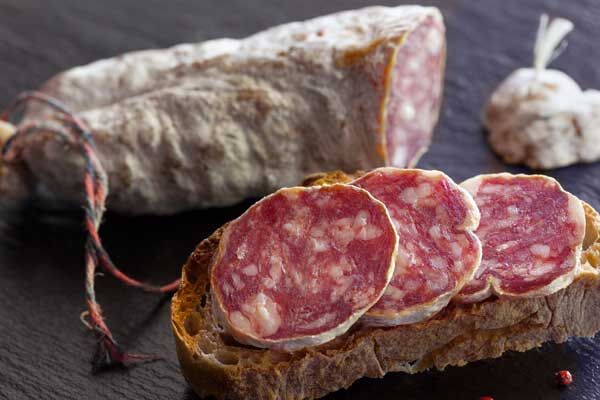
That fine white powder covering dry saucisson is neither flour nor a flaw: it is the bloom, a mix of noble moulds and yeasts that develop naturally during drying. It regulates humidity, protects the meat from harmful bacteria and takes part in developing the aromas. A white or grey bloom is the sign of successful curing — we explain it all in our article on the surface bloom of dry saucisson.

Should you eat the skin?

The skin of a saucisson is in fact a casing, most often natural (pork, sometimes deer or wild boar), which protects the meat during drying. Can it be eaten? If the casing is natural and the saucisson of good quality, yes, nothing forbids it — it is a matter of taste and texture. Many prefer to remove it, though, especially when it is thick or heavily bloomed. An artificial skin (collagen or plastic), on the other hand, must always be taken off. Our article Should you eat the skin of dry saucisson? settles the debate.

A charcutier's tip: if the skin sticks, wrap the saucisson in a damp cloth for a few seconds and it will come away on its own.

Dry saucisson, rosette, fuet: the essential varieties

France is said to have more than 2 000 varieties of saucisson. Being exhaustive is impossible, but here are the main families worth knowing.

The French classics

SaucissonOriginDistinctive feature
Traditional dry saucissonAll of FrancePure pork, dried 6 to 10 weeks, the aperitif benchmark
RosetteLyon regionFilled into the pig's end casing, long drying, fine grain
JésusLyon, Franche-ComtéGenerous pear shape, coarse mince, mellow texture
Saucisson d'Auvergne (PGI)AuvergneProtected geographical indication since 2016, controlled fat content
Saucisson de Lacaune (PGI)OccitanieNoble cuts, restrained seasoning: salt, pepper, nutmeg
Saucisson de l'Ardèche (PGI)ArdècheDried in the mountain climate of the Ardèche, natural grey-green bloom
Saucisson de SavoieSavoieDried at altitude, smoked or reblochon versions
Saucisse sècheSouth of FranceThinner than saucisson, shorter drying, often folded
Saucisson de Lyon, garlic saucissonLyon regionCooked saucissons, to poach or to eat cold

The Spanish and European cousins

Saucisson does not stop at the border. Spain, our second charcuterie homeland at Directos.eu, offers marvels :

  • Catalan fuet: thinner and shorter than French saucisson, filled into a small-calibre casing, with a characteristic white bloom and a slightly sweet taste. Discover what sets Catalan fuet apart from other saucissons or browse our selection of fuets.
  • Chorizo: this « red saucisson » owes its colour and character to pimentón, Spanish paprika. Mild or hot, it is eaten raw or cooked.
  • Longaniza: a lightly spiced Spanish dry sausage, with authentic flavours, resembling a long farmhouse chorizo.
  • Salami: the Italian interpretation, very finely minced and generously spiced.

Flavoured and unusual saucissons

The creativity of charcutiers knows no limit: saucisson with cheese (goat, blue, comté…), with hazelnuts, with figs, with Espelette pepper, with ceps or with herbes de Provence. These variants bring a welcome touch of originality to an aperitif board — to be used alongside the classics, never in their place.

Beyond pork: beef, game, poultry

Pork has no monopoly on the casing. Beef saucisson wins people over with its mildness, those of wild boar, deer or pheasant with their character, and duck or poultry saucissons offer an alternative to those who do not eat pork. Worth mentioning too are mini saucissons, perfect for nibbling, and the rising trend of saucissons with no added nitrite, as close as possible to the original recipe.

Labels and appellations: PGI and Label Rouge

Two reliable markers for buying with your eyes closed. PGI (Protected Geographical Indication) guarantees that at least one stage of production takes place in the area of origin, under strict specifications: the saucissons of Auvergne, Lacaune, the Ardèche and the Ardennes benefit from it. Label Rouge certifies a quality superior to the standard product, from farming to curing. The « montagne » mention, for its part, requires farming and making in a mountain area, where the dry climate is ideal for drying.
 

🎁🐷


A Sausage FREE
from 30€ of purchase!

Chosen from the selection of sausages or fuets from the Keesbo range, it will be added to your basket automatically! (if eligible).
When ordering pork-free sausages, a pork-free product will be selected!
Offer cannot be combined, reserved for individuals, valid once per customer, from 30€ of purchase

How to choose a good saucisson?

Artisan or industrial saucisson: the real differences

An artisan dry saucisson is recognised by how it is made: prime pork, ideally free-range, coarsely minced, simple seasoning that lets the meat speak, filled into a natural casing tied by hand, and above all a slow drying of several weeks in open air. The industrial one banks on speed: accelerated fermentation, artificial casings, colourings and flavourings to make up for what time was not given the chance to build. Cut a slice and the difference is obvious — to the eye and to the palate.

The criteria that do not lie

  • The ingredient list: short is a good sign. Pork, salt, spices, natural casing. Be wary of endless lists packed with additives.
  • The bloom: a natural, irregular white bloom betrays authentic curing; a perfectly uniform white may signal artificial talcing.
  • The feel: a good dry saucisson is firm without being hard as wood. Too soft and it lacks drying; too dry and it is past its prime.
  • The origin: favour free-range pigs and artisan making in a traditional curing house.
  • The fat: visible, well distributed, white rather than yellow — it is what carries the aromas.

What price for a good saucisson?

Expect on average €25 to €35 per kilo for a quality artisan dry saucisson, i.e. €5 to €9 a piece for a classic 170 to 300 g format — the PGI, cheese or game versions sitting at the top of the range. Below €15/kg, ask yourself questions about the origin of the meat and the drying time. Buying online direct from the curing house often gives better value for money than a supermarket, with superior freshness.

And if you are still hesitating, our selection has already done the sorting for you: selected meats, natural casings, traditional drying, fast delivery across Europe. To discover several varieties at once, our tasting boxes are the best starting point — and an excellent gift idea.

Discover our selection of dry saucissons sourced from local producers

How to store a dry saucisson: cellar, fridge or freezer

In open air, the royal method

Dry saucisson likes dry, airy places, between 12 and 20 °C, away from light. Hang it in a cellar, a pantry or a not-too-heated kitchen, or slip it into a clean cotton cloth. A saucisson box pierced with holes is also an excellent ally: it protects while letting the meat breathe.

In the fridge

For want of anything better, the vegetable drawer of the fridge will do: wrap the saucisson in a cotton cloth to limit humidity and preserve the aromas. Remember to take it out a quarter of an hour before tasting so it recovers its full aromatic range. Find all our advice on how and how long to store a dry saucisson.

Can you freeze a saucisson?

Yes, freezing saucisson is possible and allows storage for several months. Wrap it in airtight film, pushing out the air pockets, then let it thaw for 24 hours in the fridge before serving. The texture may change slightly, but the flavours are still there.

How long does it keep?

A quality dry saucisson has no strict use-by date: curing and drying make it a stable product, which keeps for several weeks, even several months — it will simply carry on drying and firming up. The only warning signs: a weeping appearance, a rancid smell or liquid beading on the surface. A white, grey or even greenish bloom, on the other hand, is perfectly normal.


🚚


Shipping
FREE
in United-Kingdom 

Valid for delivery to a pick-up point, orders over €40
Offer reserved for individuals, valid for all your orders

Tasting: slicing, boards and pairings

The art of slicing

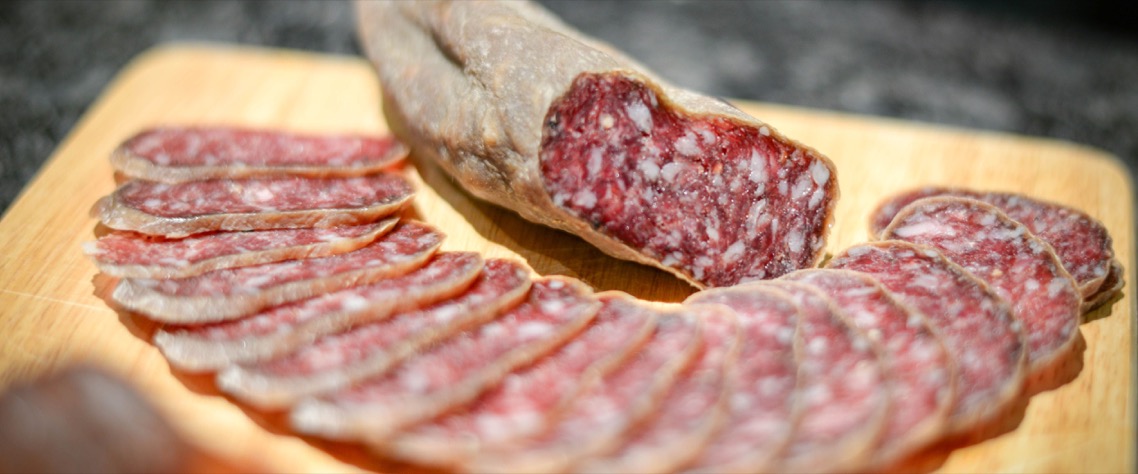
Take the saucisson out of the cold 15 minutes beforehand. Cut slices at an angle, neither too thin nor too thick (3 to 5 mm): thin enough for tenderness, thick enough for bite. A well-sharpened knife or a saucisson guillotine will do a clean job.

Building the perfect aperitif board

Saucisson is the pillar of any successful aperitif board. Our golden rules: vary the textures and tastes (a classic dry saucisson, a fuet, a chorizo, a rosette), add complementary cheeses, fresh or dried fruit (grapes, figs, hazelnuts), gherkins and good country bread. Allow 80 to 100 g of charcuterie per person for a dinner-style aperitif, half that for a simple drink.

Which wines with saucisson?

Counter-intuitively, the fat of saucisson hardens the tannins of powerful reds. Prefer light, fruity reds (Beaujolais, Gamay, Pinot noir) or be bold with a dry, lively white (Mâcon, Chenin, Riesling) that cuts through the fat with freshness. An amber craft beer or a dry cider also work wonders.

Nutrition and health

Let us be honest: saucisson is a rich pleasure. Expect roughly 400 to 460 kcal per 100 g of dry saucisson, with a good protein content (about 25 g) but also fat and salt. It is also a useful source of B vitamins, iron and zinc. The key, as always: moderation — a few quality slices are worth more than half an industrial saucisson.

Pregnant women: dry saucisson is a raw cured meat. As a precaution against toxoplasmosis and listeriosis, it is not advised during pregnancy, unless medical advice says otherwise. We detail the cured meats that are allowed and those to avoid in our article Charcuterie for pregnant women: what you need to know.

Cooking with saucisson: from brioche to chocolate

Saucisson brioché, the Lyon emblem

A cooked saucisson (pistachio-studded for preference), a soft brioche dough, a good hot oven: saucisson brioché is the summit of Lyonnais charcuterie art. Served warm in thick slices with a green salad, it turns any lunch into a bouchon lyonnais. Our step-by-step recipe guides you from the dough to the turning out.

Chocolate saucisson, the dessert that fools everyone

No pig was disturbed in this recipe: chocolate saucisson is a no-bake dessert that imitates the shape of the real thing, with melted chocolate, crushed biscuits and a veil of icing sugar standing in for the bloom. A classic of childhood teatimes, perfect for amusing guests at the end of a meal.

And day to day

Dry saucisson slips in everywhere: diced in a salad or a savoury cake, thinly sliced on a white pizza straight out of the oven, in a sandwich with salted butter and gherkins in a crusty baguette — the legendary « jambon-beurre » has a serious rival.

FAQ: your questions about saucisson

What is the difference between saucisson and saucisse sèche?

Mainly the calibre: saucisse sèche is filled into a thinner casing, dries faster and offers a more supple texture. Saucisson, being larger, dries longer and develops deeper aromas.

Why is my saucisson hard?

It has dried too much, often because of air that is too dry or storage that has gone on too long. To soften it, wrap it for a day or two in a damp cloth or place it in the vegetable drawer of the fridge.

Is the green bloom on my saucisson dangerous?

No. White, grey or greenish, the bloom is a normal noble mould on an artisan saucisson. Only a weeping appearance, a rancid smell or a sticky casing should alert you.

How long does a saucisson keep?

Several weeks to several months in good conditions (12 to 20 °C, dry, away from light). It has no strict use-by date: it simply carries on drying over time.

Which saucisson for a raclette?

Rosette, thinly sliced dry saucisson and mild chorizo go beautifully with cured ham and viande des Grisons. Allow 150 to 200 g of charcuterie per person.

Can you eat saucisson while pregnant?

As dry saucisson is a raw cured meat, it is not advised during pregnancy as a precaution against toxoplasmosis and listeriosis. Cooked cured meats (cooked ham) remain allowed.

What is the price of a good artisan saucisson?

Between €25 and €35 per kilo, i.e. €5 to €9 for a saucisson of 170 to 300 g. A markedly lower price often hides meat of doubtful origin or a shortened drying.

Where to buy artisan saucisson online?

Favour specialist sites working directly with curing houses: traceability of the meat, natural casing, traditional drying and fast dispatch. That is exactly what we offer at Directos.eu, with delivery across Europe.

Order your dry saucissons delivered in 48h — a surprise saucisson free from €30 of purchase

Saucisson, a heritage to share

From the casing tied by hand in a Catalan or Ardèche curing house to the board set down in the middle of the table, saucisson tells 2 000 years of history, of terroirs and of shared conviviality. You now know how to choose it, store it, slice it and cook with it like a connoisseur.

All that is left is to put it into practice: our fuets and our tasting boxes are waiting for you, dispatched quickly and with care. Enjoy!

🎁🐷


-20% off
on your first order!

Taking the first step is not an easy thing! This is why, to help you make the (right) choice, we are offering you this immediate discount on your first order,
with the code: JEMELANCE

Non-cumulative offer, reserved for individuals, valid once per customer, from 30€ purchase, excluding subscription.

I’m taking advantage of the offer 👉

Newsletter

Receive our new products, our tips and our promotions directly in your email box
You may well receive a surprise when you subscribe... 🤞

We will only send you information related to our site, only twice a month, and you can unsubscribe at any time!

Newsletter